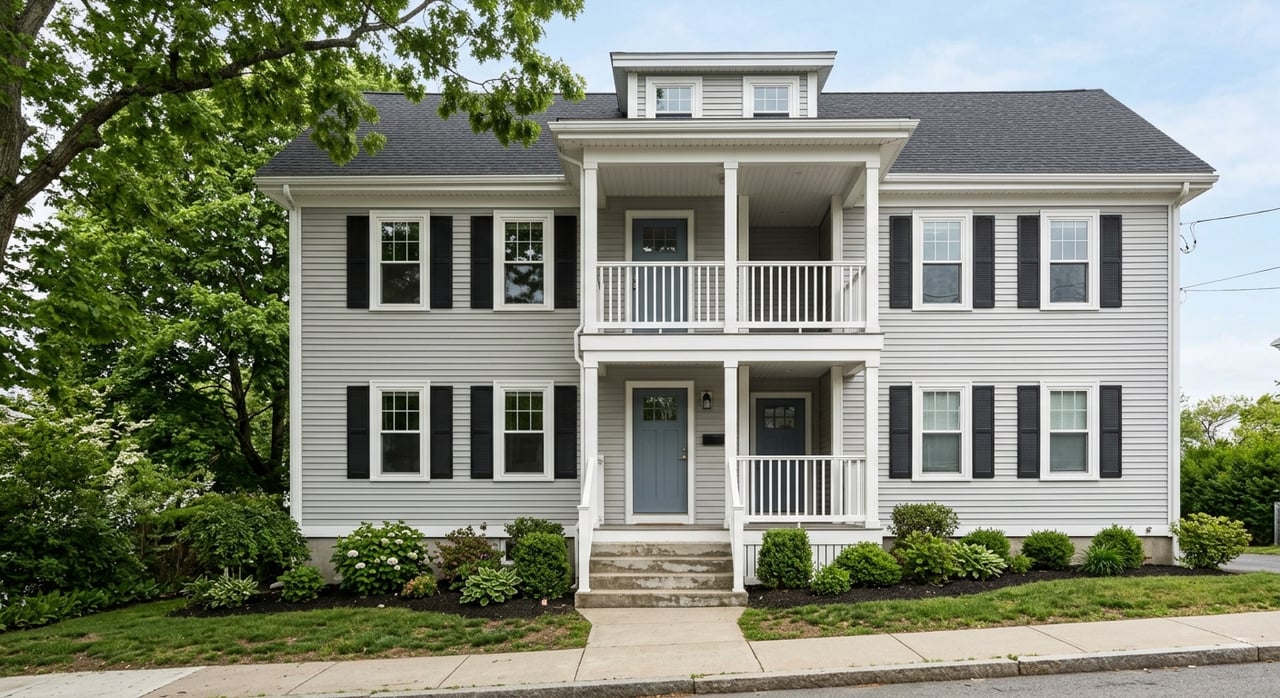
If you are looking at a Providence multi-family and the numbers seem better on paper than they feel in real life, you are not imagining it. A lot of small-property buyers mix together asking rents, lender math, and true operating income, which can make a deal look stronger than it really is. If you understand how Providence rents, taxes, and cap rates fit together, you can evaluate a property with much more confidence. Let’s dive in.
Why Providence underwriting gets confusing
In Providence, one of the biggest mistakes buyers make is treating all rent numbers as if they mean the same thing. They do not. The rent you see in a listing, the rent a lender may use for qualification, and the income you use to calculate cap rate all serve different purposes.
That matters even more in a city where taxes can shift sharply based on property type and occupancy status. If you blur those lines, it is easy to overestimate income, underestimate expenses, and misread the real return on a property.
Start with three separate numbers
When you underwrite a small multi-family in Providence, keep these three figures separate from the start:
- Asking rent
- Lender-usable rent
- Net operating income, or NOI
Asking rent helps you understand the current market. Lender-usable rent helps show what income may count toward loan qualification. NOI is the number used to estimate cap rate because it reflects income after operating expenses.
If you combine those figures too early, your analysis can go off track fast. A property can have strong asking rents and still produce a modest cap rate once taxes and other expenses are included.
What Providence rents look like right now
As of May 16, 2026, Zillow reports the average Providence rent at $2,111 across all bedrooms and property types. Its breakdown shows $1,900 for a one-bedroom, $2,200 for a two-bedroom, $2,300 for a three-bedroom, and $3,900 for a four-bedroom. Zillow also reports that average rent is down $88 year over year.
Those numbers are useful as a current market snapshot, especially when you are pressure-testing an asking price or reviewing a rent roll. But they are not the same thing as Census rent data, and they should not be swapped in as if they were.
Census QuickFacts for Providence, using 2020 to 2024 data, shows a 41.4% owner-occupied housing-unit rate and a median gross rent of $1,408. Census defines gross rent for renter-occupied units, while asking rent is a different measure tied to vacant units offered for rent. Both data points can help you, but they answer different questions.
Why asking rent is not lender rent
A common investor mistake is assuming that if a unit rents for $2,200, the full $2,200 will help with financing. In many cases, that is not how lender math works.
Fannie Mae states that when current lease agreements or market rents are used, qualifying rental income is typically calculated at 75% of gross monthly rent. The remaining 25% is meant to account for vacancy loss and ongoing maintenance expenses. For a 2 to 4 unit property, the lender typically relies on unit-by-unit rent documentation and Form 1025.
So if a unit rents for $2,200 per month, a lender may count $1,650 per month for qualifying purposes, not the full amount. That does not mean the property only earns $1,650. It means the lender is using a more conservative number for underwriting.
Why cap rate uses NOI, not gross rent
Cap rate is often discussed casually, but the formula is straightforward. The Appraisal Institute summarizes the relationship as income divided by value. In practice, that means cap rate is based on NOI, not gross rent.
That distinction matters because gross rent is only the starting point. Before you can estimate cap rate, you need to account for vacancy and operating expenses like taxes, insurance, repairs, and management.
If you simply divide annual gross rent by purchase price, you are looking at gross-rent yield, not cap rate. Gross-rent yield can be a quick screening tool, but it is not the same thing as the return generated by the property after operating costs.
Providence taxes can change the math quickly
In Providence, tax class is one of the most important variables in a multi-family pro forma. The city’s FY26 ordinance classifies 2 to 5 unit residential property as Class 1B and 6 to 10 unit residential property as Class 1C.
For Class 1B properties, the non-owner-occupied rate is $14.00 per $1,000 of assessed value. The owner-occupied rate is $7.55 per $1,000. For 6 to 10 unit properties, the rate is $26.00 per $1,000.
That means you cannot assume a 5-unit and a 6-unit building will carry similar city taxes. In fact, Providence’s $26.00 per $1,000 rate for 6 to 10 unit buildings is 85.7% higher than the $14.00 per $1,000 investor rate for 2 to 5 unit properties.
The city collector also notes that Providence sends annual bills in June and processes quarterly payments. So even if your annual tax estimate is accurate, you still need to plan for the timing of those cash outflows.
House-hack versus investor math
Occupancy status matters too. On a $600,000 two-unit, the non-owner-occupied city tax would be $8,400 per year. At the eligible owner-occupied rate, that same property would be $4,530 per year.
That is a meaningful difference. If you are planning to live in one unit, your numbers may look very different from those of a pure investor buying the same property.
Providence limits the owner-occupied rate and homestead exemption to natural persons who qualify. So if you are comparing a house-hack to an investment purchase, make sure you model the right tax treatment before deciding whether the deal works.
Sample Providence deal: two-unit
Here is a simple example using current Providence rent averages. If both units in a 2-unit property rent at the Zillow average for a two-bedroom, or $2,200 per month, the building produces $52,800 in annual gross rent.
On a $600,000 purchase price, that equals an 8.8% gross-rent yield. But again, that is not the cap rate.
Using an illustrative operating stack of 5% vacancy, 8% management, $2,500 in repairs, $2,500 in insurance, and the Providence city tax of $8,400, the NOI is about $32,536. That produces a cap rate of about 5.4%.
For financing, Fannie Mae would count only $39,600 of that annual rent for qualifying purposes. That is another good reminder that the income used to size a loan is not the same as the income used to calculate cap rate.
Sample Providence deal: three-unit
Now consider a 3-unit using Zillow’s current averages of $1,900 for a one-bedroom, $2,200 for a two-bedroom, and $2,300 for a three-bedroom. That produces $76,800 in annual gross rent.
At an $850,000 purchase price, the gross-rent yield is about 9.0%. After applying the same style of illustrative expense stack and a Providence city tax bill of $11,900, NOI comes to about $47,916.
That works out to a cap rate of roughly 5.6%. For lender qualification, Fannie Mae would count $57,600 of that annual rent.
Three Providence misreads to avoid
Providence buyers can save themselves a lot of frustration by watching for three very common mistakes:
- Using asking rent as if it were lender-usable rent
- Using owner-occupied tax rates in an investor pro forma
- Treating a 5-unit and 6-unit building as if they face the same city tax structure
Each one can materially change your analysis. Put together, they can make a borderline deal look safe when it is not.
A better way to read the numbers
If you are evaluating a small multi-family in Providence, it helps to move through the math in order. Start with market rent, then convert that into a realistic income picture, then account for local expenses, and only after that estimate cap rate.
A simple framework looks like this:
- Check current market asking rents for similar unit types.
- Separate lender qualification math from your investment analysis.
- Use the correct Providence tax class based on unit count and occupancy.
- Estimate vacancy and operating expenses before discussing cap rate.
- Calculate NOI first, then divide by value to estimate cap rate.
That process gives you a cleaner read on whether a property fits your goals. It also helps you compare opportunities more fairly across Providence’s different building types and price points.
Why this matters for Providence buyers
Providence offers real opportunity for small-scale investors and owner-occupants, but the details matter. A deal that looks excellent based on listing rents alone may feel very different once you plug in conservative lender income and the right city tax rate.
That is why local context matters so much. In Providence, good underwriting is not just about finding rent comps. It is about understanding how local tax classes, occupancy status, and lender rules shape the real picture.
If you are thinking about a two-family, three-family, or another small multi-family purchase, clear underwriting can help you avoid expensive assumptions. It can also help you move faster when the right property shows up.
If you want a second set of eyes on a Providence multi-family opportunity, Alicia Cotter Reynolds brings local market knowledge and mortgage-fluent guidance to help you read the numbers with confidence.
FAQs
What is the difference between asking rent and gross rent in Providence?
- Asking rent reflects current market pricing for units offered for rent, while Census gross rent refers to renter-occupied units and is a different measure.
How do lenders calculate rental income for a Providence 2-4 unit property?
- When current leases or market rents are used, Fannie Mae typically counts 75% of gross monthly rent for qualifying purposes.
What tax rate applies to a Providence non-owner-occupied 2-5 unit property?
- Providence’s FY26 tax rate for non-owner-occupied 2-5 unit residential property is $14.00 per $1,000 of assessed value.
How is cap rate calculated for a Providence multi-family property?
- Cap rate is based on net operating income, or NOI, divided by property value, not on gross rent alone.
Why does a Providence 6-unit building underwrite differently than a 5-unit building?
- Providence taxes 6-10 unit residential property at $26.00 per $1,000, which is much higher than the $14.00 per $1,000 rate for non-owner-occupied 2-5 unit property.
Does Providence owner-occupied status change multi-family property taxes?
- Yes. On qualifying 2-5 unit property, the owner-occupied rate is $7.55 per $1,000 instead of the $14.00 per $1,000 non-owner-occupied rate.