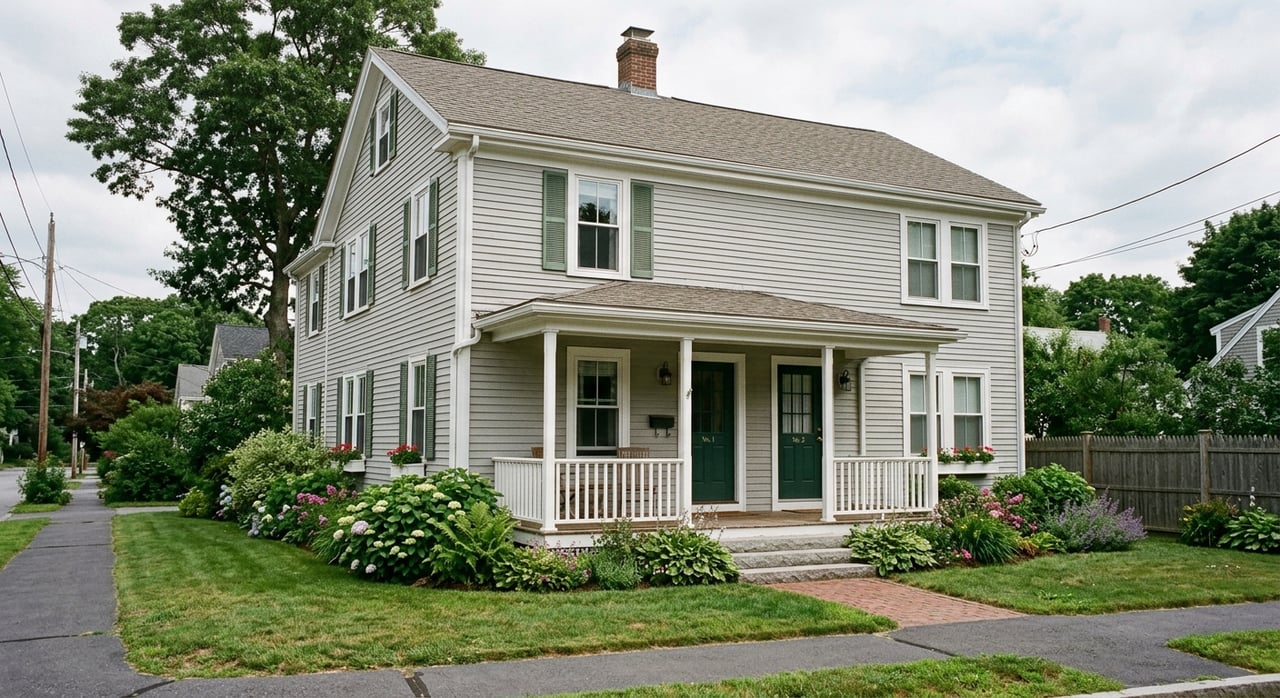
Wondering whether a single-family home or a multi-family property makes more sense in Bristol? You are not alone. In a market with rising prices, limited supply, and older housing stock, the right choice depends on more than just what looks good in a listing. This guide will help you compare both options so you can make a smart decision based on your lifestyle, budget, and long-term goals. Let’s dive in.
Bristol housing choices at a glance
Bristol is still a largely owner-occupied market, and single-family homes make up most of the housing stock. The town’s June 2025 housing chapter draft, using 2022 ACS data, reports that 70.2% of housing is owner-occupied and 70.2% of homes are single-family. Two-family homes make up 11.9% of the stock, while multi-family homes with three or more units make up 17.9%.
That matters because the local market naturally offers more single-family options than small multi-family ones. If you are hoping to buy a duplex or a three-family, you may have fewer choices and more competition for the properties that do come up.
Bristol market conditions matter
Bristol is not an easy market for indecisive buyers. The town reports that the median sales price rose from $280,000 in 2014 to $627,394 in 2024. Realtor.com reported a March 2026 median listing price of about $689,500, around 48 homes for sale, and a median 27 days on market, while also calling Bristol a seller’s market.
In plain terms, homes can move quickly, and pricing is not low. That makes it even more important to decide early whether you are buying mainly for lifestyle or whether you need the property to also serve as an income-producing asset.
Choose single-family for simpler living
If your main goal is privacy, space, and a simpler day-to-day experience, a single-family home will usually be the better fit. You do not need to think about tenants, rent collection, shared walls, or the extra moving parts that come with managing more than one household on a property.
This path also fits the way Bristol is built. Since the town is still mostly owner-occupied and predominantly single-family, many buyers find that a detached home lines up well with what they expect from living in Bristol.
Single-family benefits in Bristol
A single-family home may be the better choice if you want:
- More privacy
- Fewer property management responsibilities
- A home that functions primarily as a personal residence
- A simpler maintenance and insurance setup
- A buying process focused more on livability than rental math
That does not mean single-family is always easier financially. Bristol prices are high, and the town also notes that housing production has averaged about 20 new units per year since 2015, which suggests limited new supply. Limited supply can keep pressure on prices and competition.
Choose multi-family for income support
A multi-family property usually makes the most sense when the purchase needs to do double duty. If you want a place to live and a way to offset your monthly housing cost, a two- to four-unit property can be worth a serious look.
In Bristol, this strategy can be especially appealing because prices are high and rental demand exists. Realtor.com showed a median rent of about $2,200 in March 2026. That figure gives you a rough sense of possible income, but you should be conservative because actual numbers depend on condition, vacancy, repairs, insurance, and local demand at the time you buy.
Multi-family benefits in Bristol
A small multi-family property may be the better choice if you want:
- Rental income to help offset housing costs
- A path toward building equity with added income potential
- A property that can serve both personal and financial goals
- Flexibility to live in one unit and rent the others
For many buyers, this is the appeal of the house-hack model. You live in one unit, collect rent from another, and use that extra income to support the budget.
Financing can favor owner-occupied multi-family
One of the biggest advantages of buying a small multi-family as your primary residence is financing flexibility. HUD says FHA loans are available on one- to four-unit properties. Fannie Mae also says rental income from a two- to four-unit principal residence can be used in underwriting when you occupy one unit and the income is documented appropriately.
That can make a multi-family purchase more realistic than many buyers first assume. If you qualify based in part on rental income, you may be able to stretch into a property that would otherwise feel out of reach.
Can you use rent to qualify?
Yes, in some cases you can. If the property is a two- to four-unit principal residence, rental income may be used in underwriting when it is documented under agency guidelines.
This is where clear mortgage guidance matters. A property may look promising on paper, but the details of lease assumptions, market rent support, and lender documentation can change the picture quickly.
Bristol taxes can shift the math
Bristol gives owner-occupied residential property a lower tax rate than non-owner-occupied residential or commercial property. For FY26, the town lists $9.60 per $1,000 for owner-occupied residential property and $10.61 per $1,000 for residential non-owner-occupied/commercial property.
That difference is $1.01 per $1,000 of assessed value. It may sound small at first, but on a Bristol-priced property, it can become meaningful over time.
Why owner occupancy matters
The town says owner-occupied residential real estate can include no more than five dwelling units. It also requires homeowners to apply or re-apply for this classification between January 1 and March 15 each year.
For buyers considering a small multi-family, that creates an important planning point. An owner-occupied duplex, triplex, or other qualifying small property may pencil better than the same building held strictly as a non-owner-occupied investment.
Zoning can make or break a deal
If you are leaning toward multi-family, zoning should be one of your first checks, not an afterthought. In Bristol, multi-family housing is allowed by right in R-6, LB, D, W, and MMU zones, with upper-floor-only limits in MMU. Two-family dwellings are also allowed by right in R-8 and R-10, and two-household dwellings may be permitted in R-15 and R-20 if one unit is deed-restricted affordable.
That is why the listing description alone is not enough. The town’s zoning page makes clear that the zoning ordinance, zoning map, dimensional table, and zoning board process all matter.
What to verify before you buy
Before assuming a duplex or small apartment building is legal as used, verify:
- The parcel’s zoning district
- Whether the current use is allowed by right
- Whether any special-use approval or variance applies
- Whether the existing layout matches legal use and occupancy
- Whether future plans, such as adding units or changing use, are actually feasible
This step is critical in Bristol because location is a major part of what makes a multi-family purchase practical.
Older homes raise the stakes
Whether you buy single-family or multi-family, Bristol’s older housing stock deserves close attention. The town says the median home was built in 1966, and 32.5% of homes were built before 1949.
Older homes can offer character and established locations, but they can also bring more maintenance and rehab costs. That is true for a classic single-family house, and it is even more important if you are counting on rental income from a small multi-family.
Costs to think about
When comparing property types, be realistic about:
- Roof, siding, and exterior upkeep
- Heating, electrical, and plumbing updates
- Unit turnover costs in rental property
- Insurance costs tied to building age and use
- Ongoing repair reserves
A property that looks like a great income opportunity can become much less attractive if deferred maintenance is extensive.
More units can mean more oversight
There is also a practical compliance difference as unit count rises. Bristol Fire says life safety inspections are required for apartment buildings with four or more individual living units. Smoke and carbon monoxide inspections are offered to single-family, two-family, and three-family homes.
That does not mean a four-unit is a bad idea. It does mean that as the number of units increases, the operational side of ownership can become more involved.
A simple way to decide
If you are stuck between the two options, use this basic rule. Choose a single-family home if the purchase is primarily about how you want to live. Choose a multi-family property if the property also needs to function as an income-producing asset.
In Bristol, that distinction matters even more because supply is tight, housing is older, and local tax and financing rules can reward owner occupancy. The right answer is not the same for every buyer. It depends on whether you want simplicity and privacy, or whether you are willing to trade some convenience for income support and long-term flexibility.
If you want help comparing Bristol single-family and multi-family opportunities with a local, financially informed perspective, Alicia Cotter Reynolds can help you sort through the numbers, the zoning questions, and the real-world tradeoffs.
FAQs
Should you buy a single-family home in Bristol for lifestyle reasons?
- Yes, a single-family home is often the better fit if you value privacy, simpler day-to-day living, and fewer landlord responsibilities.
Can you use rent from a Bristol multi-family property to help qualify for financing?
- Yes, for a two- to four-unit principal residence, documented rental income may be used in underwriting under agency guidelines.
Does Bristol offer a tax break for owner-occupied multi-family property?
- Yes, Bristol’s FY26 owner-occupied residential rate is lower than the non-owner-occupied/commercial rate, and the lower class can apply to residential property with no more than five dwelling units.
Where are duplexes and small multi-family properties allowed in Bristol?
- Bristol allows multi-family by right in R-6, LB, D, W, and MMU zones, with upper-floor-only limits in MMU, while two-family dwellings are also allowed by right in R-8 and R-10.
Do four-unit properties in Bristol have more compliance requirements?
- Yes, Bristol requires life safety inspections for apartment buildings with four or more individual living units.
Why does the age of Bristol homes matter when choosing between single-family and multi-family?
- Bristol’s housing stock is older, with a median build year of 1966 and 32.5% of homes built before 1949, which can increase maintenance and rehab costs for either property type.