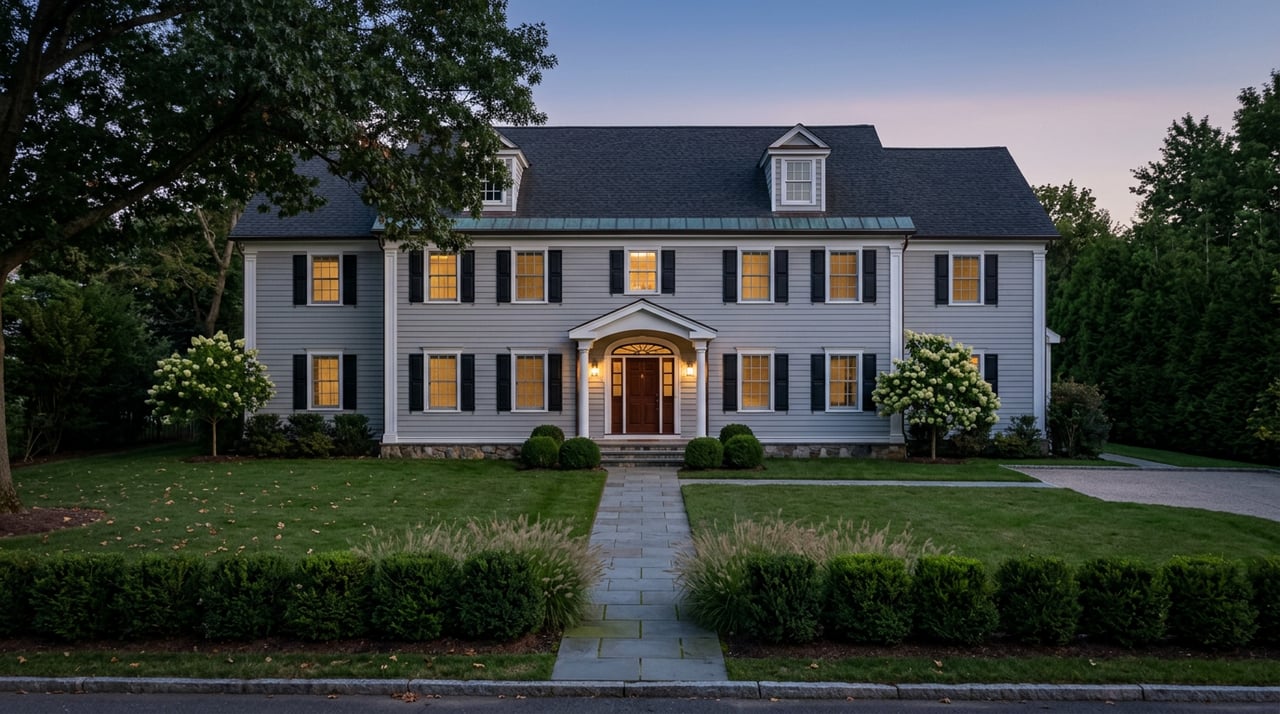
On August 26, 2026, a waterfront estate on Nayatt Road closed for $11.9 million. It's the highest price ever paid for a single-family home in Barrington, and it now stands as Rhode Island's highest residential sale of the year. If you've been watching Barrington's numbers on the major portals, you've probably also noticed something that looks alarming: the town's average home price is reported up 60 percent over the past year. Those two facts are connected, and understanding how is more useful to an ordinary Barrington seller than either number on its own.
Four Years, Two Listings, One Record
The house at 85 Nayatt Road has a history worth knowing before you look at what it did to the town's statistics. It was originally built by former PGA Tour golfer Brad Faxon. Lance and Holly Sheffield bought it in 2021 and spent nearly four years gutting and rebuilding it, with Lance doing much of the woodwork, flooring, and architectural detailing himself. When they finally brought it to market in the summer of 2025 through the Kirk-Schryver Team at Compass, the asking price was $12 million, more than double the previous record sale in Barrington's history. The listing team described it plainly: "a class of one."
That $12 million ask didn't produce a quick sale. The property sat, got relisted the following spring at $13 million through Engel & Völkers Oceanside, and eventually closed on August 26 at $11.9 million, below both asking prices but still nearly triple what the Sheffields paid for it in 2021. Even a genuinely one-of-a-kind property, backed by a well-known athlete's name and a four-year renovation, took two listing cycles and a price cut to find its buyer. That's worth remembering the next time someone tells you a hot market guarantees a fast sale at full ask.
What One Sale Does to a Town-Wide Average
Here's where it gets useful for anyone reading Barrington's market data right now. As of August 2026, the reported average home price in Barrington sat at $1.24 million, up 60 percent from a year earlier. Over the three months ending in August, the median sale price came in lower, at $942,000, up 34.6 percent year over year. Meanwhile, a repeat-sales price index for the same town, current as of the end of June 2026, showed the average home value at $807,567, up just 2 percent over the past year.
Three numbers, three different stories, all describing the same town in the same stretch of 2026.
| Metric | Time Window | Value | Change |
|---|---|---|---|
| Average sale price | Last month (Aug. 2026) | $1.24M | +60.0% YoY |
| Median sale price | 3 months ending Aug. 2026 | $942K | +34.6% YoY |
| Repeat-sales value index | As of June 30, 2026 | $807,567 | +2.0% YoY |
The gap isn't a data error. It's math doing exactly what math does when one transaction is nearly fifteen times the size of a typical sale. Barrington sells roughly 90 homes a month. Drop an $11.9 million closing into that pool and the average gets pulled hard toward it, even though 89 other households just bought or sold houses that had nothing to do with a Nayatt Point estate. The median moves too, because it's still calculated from a small three-month sample where a handful of high-end closings can shift the middle. The repeat-sales index barely moves at all, because it isn't averaging prices in a given month. It's tracking how the value of the same individual homes changes over time, which is a much steadier and, for most sellers, a much more honest read on what their own house is actually doing.
If you're comparing Barrington to another East Bay town using the headline average, you're really comparing whichever town happened to have a trophy sale close during your search window. That's not a knock on the data providers. It's just what "average" means when the sample is this small and this lopsided.
Where Barrington's Real Price Line Actually Sits
The more useful number for someone deciding whether Barrington fits their budget isn't the average at all. It's the geographic gradient that's been steady for years and didn't move because of one closing on Nayatt Point.
North of Primrose Hill Road, a typical home sells in the $400,000s. Move further south and a three-bedroom, two-bath Colonial Revival tends to list closer to $700,000. Keep going toward Rumstick Point, where lot sizes grow and water access becomes common, and four-bedroom colonials can reach $3.3 million. Nayatt Point sits at the far end of that same gradient, the neighborhood where 85 Nayatt Road is located and where waterfront estates command the highest prices in town. The $11.9 million sale didn't create a new tier of the market. It's an extreme data point inside a tier that's existed the whole time.
This is the number worth asking your agent about if you're actually comparing neighborhoods: not "what's Barrington's average right now," but "what does a house like mine, on a street like mine, typically sell for." That's also, not coincidentally, the same logic an appraiser uses when underwriting a mortgage. Lenders don't value a house against a townwide average. They pull comparable sales in the same immediate area, adjust for lot size and condition, and build a value from the ground up. If you've ever wondered why a bank's appraisal came in differently than what a portal's automated estimate suggested, this is usually why.
What This Means If You're Selling an Ordinary Barrington House Right Now
If you're preparing to list a typical single-family home in Barrington this fall, the headline average is close to useless to you, and the median only slightly more useful given how few sales feed into it each month. What actually matters is recent closed sales on your street or in your immediate neighborhood, adjusted for size and condition, the same way an appraiser or an underwriter would build your home's value. That's a very different exercise from watching a portal's monthly average swing 60 percent because one house sold for twelve times what the rest of the town is transacting at.
It also means you shouldn't panic if you see a number like that and assume your own listing should suddenly command a premium it hasn't earned, and you shouldn't get discouraged if the same headline cools off next month once the comparison period rolls past this one sale. Both reactions are responding to noise, not signal.
For buyers, the practical takeaway is similar. A single record sale in Nayatt doesn't mean every corner of Barrington just got 60 percent more expensive. It means one extraordinary property changed hands, and the rest of the market is still trading roughly where the Primrose Hill-to-Rumstick gradient has placed it for a while.
A Few Straight Answers
Does the $11.9 million sale mean Barrington prices are up 60 percent? No. It means one sale was large enough to move a monthly average calculated from a small sample. The steadier repeat-sales index for the same period showed about 2 percent growth, which is closer to what most sellers actually experienced.
How do I find out what my actual neighborhood is doing? Ask for recent closed sales within a half mile or so of your home, not townwide figures. The same logic a mortgage appraiser uses to value a house for underwriting applies here: nearby comparables matter more than a citywide average ever will.
Could another trophy sale distort the numbers again? It's possible. Any town with a small monthly sales volume is vulnerable to this kind of swing whenever a high-value property closes. That's exactly why it's worth knowing how to read past the headline number instead of reacting to it every time it moves.
If you're trying to make sense of what your own Barrington home is actually worth in this market, or you're comparing Barrington to other East Bay towns and want the real numbers behind the headlines, Alicia Reynolds can walk you through the comparables that actually apply to your situation. Let's Connect.